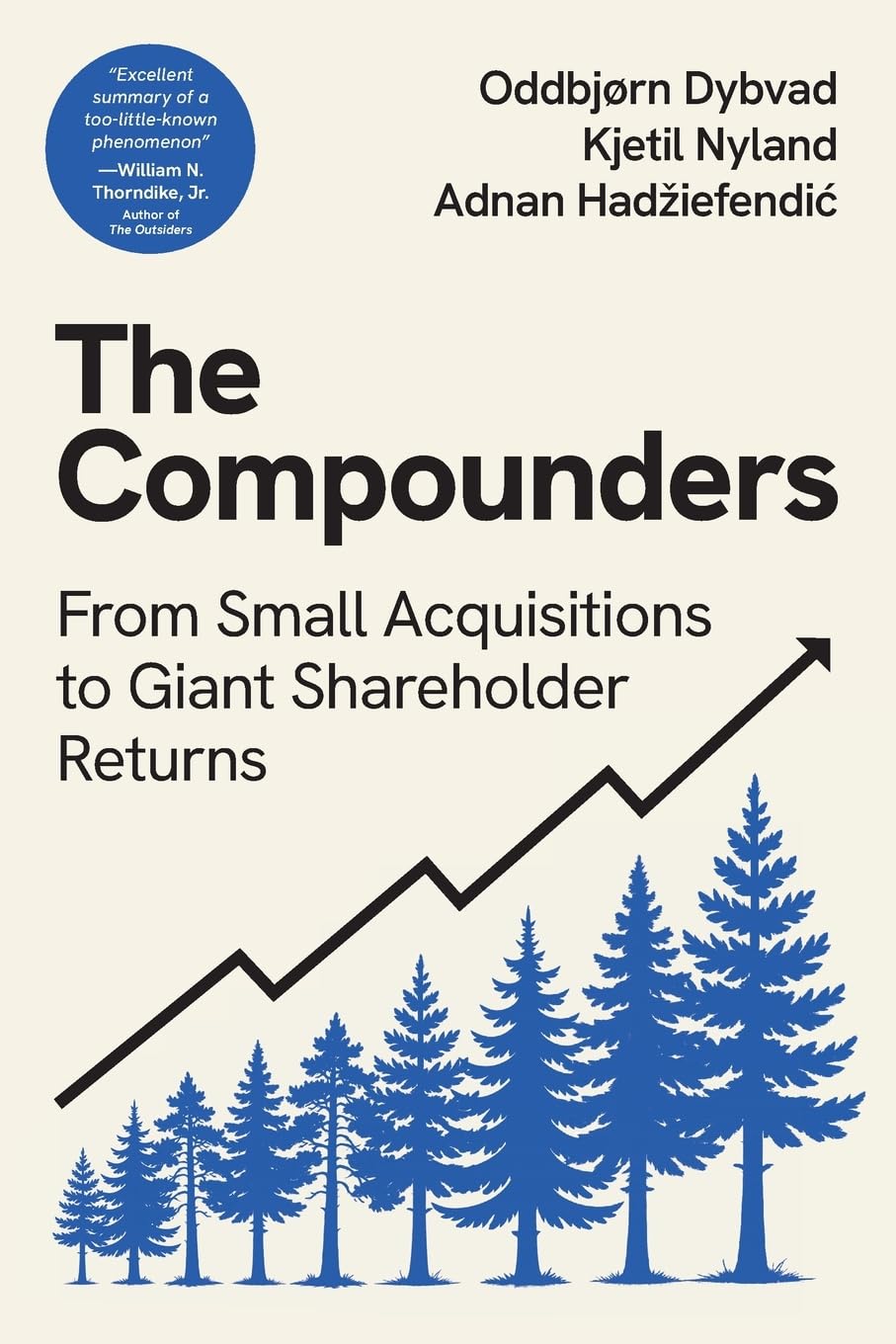
The Compounders

128 highlights across 13 themes

The book profiles nine acquisition-driven holding companies that compound shareholder value through small deals, decentralized cultures, and relentless reinvestment. These are the passages that stood out.

Formula
ROIC × Reinvestment × Time
All nine reinvest 75-85%+ of cash flows at double-digit returns. Time does the heavy lifting.
Structure
Lean HQ, local autonomy
Decisions happen close to the customer. HQ allocates capital and carries culture. Nothing else.
Discipline
Small deals at fair prices
Buy at 5-8x earnings. Fund from cash flow. Keep the business name. Repeat for decades.
Theme 01

The Compounding Formula

ROIC, reinvestment rate, and time. The three variables that drive everything.

“At its core, compounding earnings growth means sustained, exponential earnings growth over time. To achieve this, a business must do more than grow—it must reinvest its earnings at high rates of return, year after year. It’s not just about generating profits; it’s about redeploying those profits effectively to create earnings on the earnings.”
“The formula is simple: The reinvestment rate tells us how much of the cash generated by the business is being plowed back into growth. The higher the rate (assuming effective use), the greater the potential for compounding.”
“The acquisition-driven compounders featured in this book have consistently reinvested more than 80% of their cash flows, meaning that out of every $100 earned, more than $80 has been plowed back into the business. A compelling example is the Swedish company Lifco. Since its IPO in 2014, Lifco has reinvested 85% of its cash flow at an average return on capital of more than 20%.”
“For compounding to occur, incremental ROIC—the return on newly invested capital—must remain high (and higher than cost of capital) over time. Constellation Software, the Canadian vertical software market compounder, has maintained high double-digit ROIC since its IPO in 2006. This disciplined allocation of capital has allowed the company to compound shareholder wealth by an incredible 375 times in less than 20 years.”
“While dividend payments are not inherently bad—they are often preferable to low-return reinvestments—this ‘leakage’ reduces the compounding rate. A company that reinvests 75% of its earnings will grow much faster than one that reinvests only 50%.”
“During just the last four days of the 31-day period, that penny’s value soars by an additional $20m. The key insight here is that wealth creation is heavily back-loaded: early growth appears almost laughably small, but over time, momentum takes hold, and results become extraordinary.”
Theme 02

Decentralization & Autonomy

Push decisions to the front line. Keep HQ out of the way. Trust replaces control.

“These acquisition-driven compounders operate with a simple and profoundly effective philosophy: decentralization. Push daily decision-making as close to the customer as possible, give extraordinary customer service, empower people with responsibility, accountability, and shareholder-friendly incentives, and give them ample room to grow.”
“In Constellation Software, a company with approximately 25,000 employees, only ten people sit in the headquarters at Toronto (a ratio of 1:2,500).”
“When he once called headquarters for advice on restructuring production units, the response was clear and concise: ‘We have hired you with a high salary—make your own decisions!’”
“Rather than imposing a hard integration, Lagercrantz carefully integrates newly acquired companies, preserving their unique identities and operational frameworks. This includes retaining the original company name, profile, and locations, ensuring the business continues as-is.”
“For local autonomy to work in practice, Judges has had to sacrifice synergies for entrepreneurship. Instead of driving synergies, Judges encourages collaboration between companies, offering them a suite of possible opportunities.”
“Overall, Addtech deploys a ‘pull’ rather than a ‘push’ strategy. A company within Addtech has all the freedom to choose which parts of the toolbox it wants to utilize—and no obligation to select any.”
“The challenges posed by the central warehouse model underscored a critical realization for Lagercrantz’s leadership: centralization, while seemingly straightforward in its implementation, can create unforeseen complexities and stifle the entrepreneurial spirit they sought to cultivate.”
“The role of the headquarters is not to micromanage but to facilitate—to provide opportunities for managing directors, strengthening them with the tools and autonomy they need to thrive.”
Theme 03

Small, Disciplined Acquisitions

Buy small. Pay fair prices. Fund from cash flow. Repeat hundreds of times.

“Lifco has a successful history of deploying capital at high returns... The company maintains a disciplined acquisition strategy of buying small businesses. Since going public, only one acquisition has been larger than $50m in terms of sales... with a clear limit of paying no more than eight times the operating profit (EBITA).”
“Having conducted over 1,000 acquisitions over the last 20 years, Constellation Software has a unique repeatable model for buying smaller companies at scale. Historically, most acquisitions have been small software companies with sales of $1.5m–$2m, acquired for low prices due to their size.”
“Addtech’s bread and butter are small family-owned businesses around $10m–$20m in deal size. By strictly adhering to both quality and price, Addtech has consistently paid very attractive earnings multiples below 7-8×. These deals are typically too small to attract significant attention from bigger industrial players or private equity.”
“Since 1990, Heico has completed over 100 acquisitions, with a 98% success rate—a nearly flawless track record that few companies can match.”
“There is a misconception about Constellation Software. Many believe that it only buys companies of high quality... But Constellation will buy companies that aren’t profitable. That’s where its playbook comes in handy.”
“If compounding had a soul mate, it would be the group of compounders in this book. Their power lies in their ability to perfect two engines of growth: organic reinvestments and programmatic acquisitions of small private companies.”
“A significant milestone for Judges Scientific came in 2012 when the company acquired Global Digital Systems Limited (GDS) for approximately six times its earnings. GDS specialized in selling instruments for testing the physical properties of soil and rocks, generating $1.3m in operating profit.”
Theme 04

Lean HQ & Corporate Frugality

Frugality as identity. Basement offices, economy flights, no secretaries.

“One of his first actions was symbolic, and controversial: he sold Electrolux’s luxurious office in Stockholm’s central business district and relocated to a more modest location on the city’s outskirts.”
“It is no coincidence that frugality marked Indutrade throughout Gunnar Tindberg’s leadership. Excess had no home there. During its first decade, cost consciousness was so strong that the head office was based out of a basement in a residential building. The office didn’t even have a sign on the door.”
“Leonard, who stands 6’5" and weighs 280 pounds, described how he flew economy on a business trip to the UK despite the discomfort involved and his ability to afford business class. This choice wasn’t simply personal frugality but a leadership standard.”
“Lifco minimizes costs ‘that do not directly contribute to the development of the businesses within manufacturing, sales or product development.’ In Lifco’s experience, this results in lower costs and greater employee commitment.”
“Out of 1,400 employees, only a handful are employed at HQ. In Bergman & Beving today, every company is responsible for its operations, including profit and loss, balance sheet, and cash flow. The function of the small HQ is to trust but verify.”
Theme 05

Culture & Talent Development

Internal academies, mini P&Ls, meritocracy. Grow leaders from within.

“Fredrik Karlsson introduced one straightforward but successful principle: if you haven’t been CEO of an operating company within Lifco, you can’t advance to becoming a group manager.”
“AMETEK implements ‘mini P&Ls’ to develop leadership talent. These mini P&Ls typically blend two vital functions—marketing and operations, say, or engineering and production—providing a real-world setting where future leaders can sharpen their skills.”
“Bergman & Beving deemed the internal academies and the investments in its people so crucial to the future success of the company that in the 1980s it spent close to 10% of its cost base on them.”
“The Lagercrantz Academy delivers specialized training led by internal experts, promoting continuous learning throughout the group.”
“When acquisitions are embedded in the business model, success improves with each repetition. To foster this expertise, Addtech trains its business unit leaders to conduct internal commercial due diligence and valuations, reducing reliance on costly external consultants.”
“Lifco excels at utilizing knowledge across the organization and between companies and business areas. It is common for group managers to take on the chairman role in companies outside their core expertise, which enhances knowledge-sharing and networking across the organization.”
Theme 06

Incentive Alignment & Ownership

Bonuses tied to profit and capital efficiency. Leaders with skin in the game.

“If the firm increased EBITA by $100, the CEO might get 10%. But if his capital employed increases by $100, he gets a penalty of $2.5, so he or she ends up with a $7.5 bonus. [Effectively a 25% ROCE hurdle.]”
“Leonard detailed how he went through a shift in his compensation, asking to reduce his salary to zero and waive bonuses, aligning his interests even more closely with those of shareholders.”
“This metric is consolidated at the group level, with all employees’ incentives tied to it—creating full alignment between employee efforts and shareholder interests. The overarching goal is for all employees to quickly see measurable impacts on financial performance.”
“Subsidiaries and divisional managers are now evaluated on Earnings Before Tax (EBT), including internal interest on all capital used. This shift from the previous EBITA-based metric emphasizes the cost of capital and acquisition-related assets.”
Theme 07

Pricing Power & Niche Dominance

Small markets. Mission-critical products. Price setters, not price takers.

“AMETEK focuses on markets averaging $200m–300m in size, capturing a 25–30% share in each. Individually, these markets may seem insignificant, but collectively they create a powerful, decentralized portfolio built for resilience. AMETEK’s playbook is simple: dominate small, defensible markets. Be the #1 or #2 player.”
“Lifco applies a standardized approach across all acquisitions, raising prices wherever possible and discontinuing products with low pricing power. In Lifco’s way of looking at it, the best way to know if a product or service brings truly differentiated value is if you hike prices, and the customers still buy it.”
“If you have 7% operating margins, like most industrial companies have, you have to invest $93 to earn $7, a ratio of 13:1. If you have 25% operating margins you have to invest $75 to earn $25, a ratio of 3:1. It is that simple!”
“Per Waldemarson, the CEO, often points out that ‘our best managers are the ones able to defend or increase margins.’ And to increase margins, Lifco encourages its managing directors to actively sell more of high-margin products and discontinue commoditized products with lower margins.”
“These companies focus on selling products that customers need to use regularly—like parts, supplies, or tools that show up in their day-to-day running costs—not big one-off purchases.”
“Lagercrantz’s adroit navigation of the risk of commoditization when, loaded down with useless stock, it switched from product distribution to acquiring and developing niche product companies.”
Theme 08

Capital Allocation Discipline

HQ as allocator, not operator. Capital flows to the highest-return opportunities.

“Management makes sure capital flows to the best opportunities. Take Addtech as an example: each business area is incentivized to grow—both organically and through acquisitions—but must also compete for internal capital.”
“Heico views itself as ‘a vehicle that generates strong cash flow, and we do it through aerospace parts and technology.’ This is important, because it does not constrain Heico from only deploying capital into the aerospace parts industry.”
“Lifco’s capital allocation strategy is simple. The company focuses on acquiring and managing asset-light businesses, avoiding unnecessary spending on large, fancy headquarters or bloated corporate overhead.”
“In 2016, Leonard shared his findings from studying other HPCs. The key takeaway was that all the HPCs he studied followed a ‘multi-decade pattern,’ starting with solid growth from attractively priced acquisitions through to paying higher multiples... This, in turn, led to diminishing returns on capital.”
“Central to AMETEK’s growth model is its ‘strategic adjacency’ approach. When entering a new market, the company looks beyond the initial acquisition—identifying opportunities up and down the value chain, across similar industries, and in adjacent geographies.”
Theme 09

Organic Growth Alongside M&A

Acquisitions are one engine. Internal reinvestment is the other.

“Rather than prioritizing growth for its own sake, Lifco optimizes profitability and capital efficiency.”
“Addtech encourages its companies to make organic investments however they deem will create the most value. One of these organic investments that has turned into a huge success is the company Caldaro... Impressively, it grew into a business of SEK 100m ($10m), with 20% operating margins, in less than a decade.”
“As the companies it acquires are already strong in their niches, Judges typically helps to amplify that strength by building a strong sales organization and putting more resources into R&D.”
“Over the past decade, AMETEK has reinvested approximately 75% of its free cash flow into acquisitions, following a bottom-up deal-sourcing approach that originates at the business unit level.”
“Yearly gatherings and ongoing sharing of best practices on pricing, working capital, sales, business acumen, and numerous other topics help generate organic uplift—an important contributor to overall profit growth.”
Theme 10

Cash Conversion & Financial Metrics

Simple metrics that everyone can understand and act on. Cash is king.

“The first profit goal is simple, yet not easy: to double earnings every five years. The second goal focuses on maintaining a strong cash culture. Subsidiaries must adhere to a simplified return-on-capital metric that translates into a profit-to-working capital ratio of over 45% (P/WC >45%).”
“Central to the strategy was focusing on what Judges called ‘ROTIC’ (return on total invested capital). ROTIC is calculated monthly at both the group and subsidiary levels, factoring in non-amortized intangible assets and goodwill.”
“Since going public, Lifco has relied primarily on cash flow from operations to fund new acquisitions, without issuing any additional shares to fuel growth... the total dividends distributed have equaled 80% of its market capitalization at the time of the IPO.”
“Addtech’s success stems from two simple yet not easy goals: increase profits annually by 15%, and generate a return on working capital (P/WC) of more than 45%.”
“The easiest way to lower working capital is to reduce inventory, improve the time of client payments, and increase supplier payment terms.”
“The ‘Focus Model’ for different P/WC levels is as follows: Above 45%: Increase profits mainly by increasing revenue. 25–45%: Improve working capital turnover and profit margins. Below 25%: Increase P/WC before increasing revenues.”
Theme 11

Deal Sourcing & Pipeline

Proprietary deal flow. Relationships over brokers. Acquisitions as a people game.

“Crucially, Gunnar also trusted the insights of Indutrade’s best customers when it came to identifying potential acquisition targets. During a meeting with the purchasing manager at Atlas Copco... the response was: Colly Group.”
“Acquisitions are essentially a ‘people game,’ and Tindberg’s feel for personalities and relationships de-risked his acquisitions. He promised prospective sellers that he would help improve their businesses, and his background as an entrepreneur made him trustworthy.”
“After hiring new M&A managers in key markets such as Italy, Germany, and the UK, the team today consists of around 20 people dedicated to M&A. Half of those are internally developed group managers.”
“To sustain its historical growth rates while maintaining high returns, Annvik has set a target for each business area to complete 3–4 acquisitions per year. This ensures a steady pipeline of potential deals.”
Theme 12

Post-Acquisition Integration

Light touch. Keep the name. Keep the team. Add structure and accountability.

“The companies are not stripped down or flipped for profit, as in traditional private equity. Instead, the compounders offer a permanent home for entrepreneurs, allowing their businesses to continue operating independently and flourish.”
“A winning long-term strategy for Lagercrantz’s decentralized operations has been to refrain from focusing on cost synergies. Instead, it infuses its acquisitions with energy, structure, and professionalism.”
“Lifco observed that companies where entrepreneurs retained ownership performed better post-acquisition, and expanded the use of this model, further enhancing post-acquisition performance.”
“Constellation Software has ingrained a culture of continuous learning... the company conducts post-acquisition reviews (PARs), in which decision-makers analyze investments a year after the transaction, sharing valuable company insights.”
“When Lifco notices results in their subsidiaries beginning to show deviations or negative trends, group managers promptly step in to analyze and assess the situation. They quickly identify underlying issues, ensuring any potential problems are addressed before escalating.”
Theme 13

Long-Term Orientation & Patience

The returns are back-loaded. Endurance matters more than speed.

“What began as a modest investment snowballed into a fortune. She became a millionaire many times over simply by holding all that company’s shares and its spin-offs for nearly 50 years... It wasn’t about luck. It resulted from unwavering belief, calm in the face of uncertainty, and discipline to focus on the long term.”
“Achieving exponential growth—what some call reaching ‘the second half of the chessboard’—requires more than just aiming for the highest returns. It demands avoiding catastrophic losses at all costs.”
“While the company’s annual growth may seem unremarkable from the outside, Indutrade recognizes that the true power of compounding lies in sustainability. Growth is not about speed alone but about endurance.”
“The cash flow generation in Judges Scientific has been so strong that the dividends distributed have aggregated to six times the initial market capitalization at the time of its initial public offering.”
“But compounding rewards patience. It’s not about the early days. It’s about staying the course long enough for that curve to steepen and for the compounding magic to unfold.”
Synthesis

Key Takeaways

01
The formula is ROIC × reinvestment × time
All nine reinvest 75-85%+ of cash flows at double-digit returns. Time does the heavy lifting. Wealth creation is back-loaded.
02
Decentralization is the operating system
HQ stays lean. Decisions happen close to the customer. Trust replaces control. The ratio at Constellation is 1:2,500.
03
Small deals at disciplined prices
Most acquisitions are too small for PE to bother with. That is the advantage. Pay 5-8x earnings, not 10-12x.
04
Frugality signals identity
From Lifco’s CEO making coffee to Indutrade’s basement office. Frugality is not cost-cutting. It is a statement about values.
05
Simple metrics drive behavior
P/WC > 45%. ROTIC. EBITA + capital charge. Everyone can understand them. Incentives are tied directly to results.
06
Niche dominance creates pricing power
Small markets discourage entrants. Mission-critical products are sticky. Commoditized products get dropped.
07
Grow leaders from within
Internal academies, mini P&Ls, and rules like “run an opco before managing a group” build the pipeline.
08
Permanent ownership attracts better sellers
Founders sell at lower multiples because they trust their business will keep its name, team, and identity.
09
Cash culture is non-negotiable
Every employee understands how pricing, payment terms, and inventory affect cash flow. Bonuses reflect it.
10
Patience is the multiplier
These companies chase endurance, not speed. Most of the value comes from staying the course for decades.