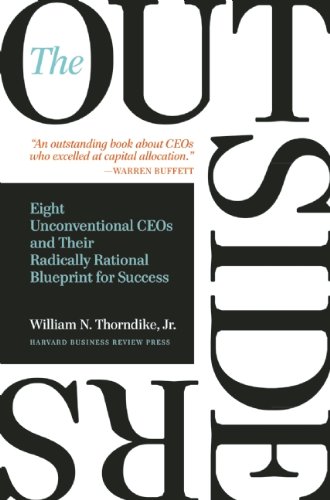
A different lens for agency owners
The Outsiders is not a book about service businesses. The eight CEOs ran public companies in defense, media, telecom, and consumer goods. But the underlying mental model translates surprisingly well to running a single agency.
Agencies are cash businesses. They live or die by pricing, utilization, and the discipline to say no. They are usually run by founders who came up through the craft and now have to make capital and people decisions they were never trained for. The same gap Buffett describes in CEOs — rising on operational excellence and then being asked to allocate capital — shows up in agencies the day the founder stops being the only person doing the work.
These are the lessons that translate. They are not about size. They are about how to run an operating company well.
What the outsiders teach agency owners
Ten lessons on pricing, talent, cash, clients, and the discipline to stay focused.
The default scoreboard in agency-land is people: how many employees, how many offices, how many disciplines under one roof. AdAge writes about it. Founders introduce themselves with it. New hires brag about it. None of it pays the bills.
Murphy ran one of the most valuable media companies in history with a tiny team and a converted convent for an office. The number that mattered was profit, and specifically profit per person who was actually doing the work. An agency that doubled headcount but kept profit flat just made everyone’s job harder for no reason. An agency that grew profit 50% while keeping headcount flat got dramatically more valuable, even though nothing in the press release would say so.
Pick the metric that actually matters: profit per partner, profit per employee, profit per client. Track it monthly. Make every decision against it. New hires, office leases, new service lines, and client wins all get evaluated against whether they move the number that pays your rent and funds your future, not the number that sounds good at conferences.
Singleton built Teledyne by buying small, profitable, niche businesses with leading market positions. The agency parallel is direct: a small specialist firm with a defined niche and a defined buyer earns multiples of what a generalist firm of the same size earns.
The temptation in agency-land is to take whatever revenue walks in the door. The discipline is to refuse work that does not fit. Stiritz killed the Van de Kamp’s frozen seafood line and the legacy agricultural feed business when they became commoditized. Agencies should do the same with service lines that have collapsed in price.
The numbers favor the specialist. A 25% margin on $5M of focused work beats a 10% margin on $10M of generic work, with less stress, fewer staff, and more pricing power.
Murphy walked away from auctions. The agency version is walking away from RFPs and walking away from clients who push price below the floor. Both are easier in theory than in practice, especially when the pipeline is thin or the team needs utilization.
Set a minimum margin. Apply it to every proposal. Pass when the math does not clear, even if it means losing the work. The deals that pencil at 60-70% of the asking price are the ones that build the business. The ones that require margin compression to win usually do not pay back over the project life because scope expands and the discount becomes the new ceiling.
Murphy’s discipline was unsexy and slow. It also made him the most successful buyer of media properties of his era.
Murphy painted only the road-facing sides of the studio. He also outspent peers on news talent because being number one in local news drove disproportionate ad revenue. The two are not contradictions. They are the same discipline applied to different categories.
For an agency: cut the things that do not produce revenue or quality. Office furniture, conference budgets, swag, soft expense categories. Spend without flinching on the things that produce craft and client outcomes: senior people, time, training, the tools the team needs to do work that wins.
Cheap agencies feel cheap. Careful agencies feel premium. The line between them is a sharp eye for what every dollar is producing.
Agencies are cash businesses. AR days, project deposits, payment terms, and utilization drive whether the company can pay its people next month. Reported profit on a project that bills net-90 with a 50% scope expansion is not the same as cash.
Track the cash conversion cycle the way the Outsiders tracked free cash flow. Bill on milestones. Take deposits. Refuse net-90 terms with new clients. Pay attention to the ratio of cash on hand to monthly burn, not the P&L margin.
One page, the cash math, every month. The agency that knows its real cash position has runway. The agency that’s only watching the P&L learns about the problem when payroll bounces.
Even at thirty people, an agency stops scaling the day every decision still has to route through the founder. Account leads waiting on staffing approvals. Discipline leads waiting for hiring sign-off. Project pricing routed up the chain. Speed dies. Quality slips. The team learns that ownership is theatre.
The trap most agency owners fall into is staying in the work too long. The same instinct that built the company — do the work yourself, well — becomes the constraint that prevents the company from growing past the founder. The Outsider CEOs delegated operating responsibility hard. They kept the few real big calls for themselves and let the operators run everything else.
For an agency, that means account leads run their own client P&Ls. Discipline leads hire their own teams. The founder sets the metrics, approves the few decisions that actually require them, and otherwise gets out of the way. The result is more leaders, faster decisions, and an agency that can grow past the size of the founder’s calendar.
Most agencies grow by adding overhead before they need it. Operations director, head of people, marketing manager, business development. Each role looks reasonable in isolation. Together they create a fixed-cost layer that has to be paid for whether the work comes in or not.
Malone ran 12 million subscribers with seventeen people at corporate. The agency principle is the same: keep the non-billable count obsessively low. Each non-billable role should have a clear line to revenue or to risk reduction. If it does not, it should be a contract or a shared service, not a salary.
The discipline pays back twice. Lower fixed costs mean higher margins in good times, and they mean the agency can survive a slow quarter without layoffs.
Buffett closed Berkshire’s textile mill in 1985 even though it was the original business that gave the company its name. The hardest decisions in an agency are usually the same shape: a service line, a client, or a team that everyone knows is broken but nobody wants to be the one to end.
The math is honest. If a service line is generating 5% margins while the rest of the firm is at 25%, every hour spent on the low-margin work is an hour stolen from the high-margin work. The question is not whether to fix the underperformer. It is whether the underperformer should exist at all.
The Outsiders were ruthless about this. They closed, sold, or shrunk anything that did not clear the hurdle. Agencies should do the same with service lines, client segments, and individual accounts that no longer fit.
Most agency decisions are small and reversible. Hire one person. Take one project. Try one offer. The big decisions are different: switching the niche, hiring a senior partner, opening a new line of service, taking on a meaningful debt.
Murphy’s pattern was to wait years for the big decisions and then act decisively when the math worked. Each major Capital Cities acquisition was 25%+ of the company. He did not stretch on the small ones. He bet the company on the right large ones.
For an agency owner: do not be impatient on the big calls. Let them form. When they do, commit. The hire that transforms the firm, the niche pivot, the partnership decision — these deserve the same conviction Murphy brought to the ABC deal.
This is where the Outsider analogy doesn’t cleanly transfer. Murphy and Singleton ran companies whose buyers came to them. Service businesses don’t have that luxury. Agencies live on referrals, demonstrated expertise, and the founder’s presence in the market. Top-of-funnel work — writing, podcasts, conference talks, point-of-view content — is often the actual sales engine, not vanity. Buffett writes one of the most-read annual letters in business. That isn’t the opposite of the Outsider posture; it’s a version of it.
The real lesson is about audience. The trap is optimizing for the wrong one — peer recognition instead of buyer attention. Awards judged by other agencies. Panel slots at industry conferences where the room is mostly competitors. Top-50 lists that read well on LinkedIn but never produced an inbound. Partner-tier badges that the buyer doesn’t care about. These activities feel like business development and are often just status games.
The test for any top-of-funnel activity is simple: does this put me in front of someone who could buy, or in front of other people who do what I do? Speak at the buyer’s conference, not the agency conference. Write for the buyer’s publication, not the trade press. Build the audience that sends checks, not the audience that sends DMs.