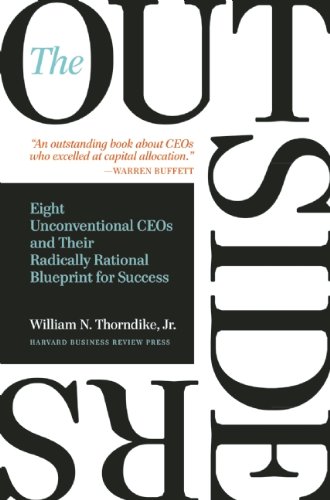
The Book
What The Outsiders actually is
William Thorndike profiles eight CEOs who delivered extraordinary shareholder returns over very long tenures. They were not media darlings. They did not give earnings guidance. Most did not appear in business magazines. None built lavish headquarters.
What they shared was a model: cash flow over reported earnings, capital allocation as the CEO’s primary job, decentralization at the operating level, and the willingness to act boldly when the math required it. Singleton bought back 90% of Teledyne’s shares in eight tender offers. Anders sold half of General Dynamics in three years and returned the proceeds. Murphy turned $1 into $204 over twenty-nine years at Capital Cities.
The thesis is simple. The two jobs of any CEO are running operations efficiently and deploying the cash those operations generate. Most CEOs focus on the first. The Outsiders gave most of their attention to the second and let the math compound for decades.
The Eight
Who are the outsiders?
Eight CEOs across media, defense, telecom, retail, and consumer goods. Different industries, same operating system.
Capital Cities
Tom Murphy
Turned $1 into $204 over 29 years. Acquired ABC, then sold to Disney for $19B. Painted only the road-facing sides of the studio.
Teledyne
Henry Singleton
Bought back 90% of shares across eight tender offers. Avoided dividends. Never split the stock. Played chess blindfolded.
General Dynamics
Bill Anders
Sold half the company in three years. Generated $5B in cash. Returned most of it to shareholders.
Berkshire Hathaway
Warren Buffett
Closed Berkshire’s textile business in 1985. First stock he ever recommended was GEICO. Built a board of owners with skin in the game.
Washington Post
Katharine Graham
Required 11% cash returns over ten years. Last major publisher on letterpress. Most skeptical buyer in the industry.
TCI
John Malone
Coined EBITDA. Spun off 14 entities. Ran 12M subscribers with 17 people at HQ. “Staff are people who second-guess people.”
General Cinema
Dick Smith
Bought the largest independent Pepsi bottler in 1968. Built a platform from theater concessions. The OOC met weekly.
Ralston Purina
Bill Stiritz
Bought Energizer in three meetings on a back-of-envelope LBO model. Spun off everything else. Sold to Nestlé for 14x cash flow.
“The goal is not to have the longest train, but to arrive at the station first using the least fuel.”
Tom Murphy, Capital Cities
The Playbook
Six principles they all shared
Different industries, different decades. The same underlying mental model.
01
Capital allocation is the CEO’s job
Five tools for deploying cash: invest, acquire, dividend, pay debt, repurchase. Three for raising it: cash flow, debt, equity. The mix is the strategy. The CEO does the math personally.
02
Cash flow, not reported earnings
Singleton called his metric the Teledyne return. Malone invented EBITDA. Quarterly earnings will jiggle. Cash is what compounds and what taxes get paid on.
03
Decentralize hard. Keep HQ tiny.
TCI ran 12M subscribers with 17 people at corporate. Teledyne had fewer than 50 in a 40,000-person company. There is a fundamental humility to decentralization.
04
Patience plus boldness on M&A
Wait years for the right deal. Then bet 25%+ of the company. Walk away from auctions. Rely on simple rules: a double-digit after-tax return over ten years, unleveraged.
05
Buybacks as a capital tool, not a signal
Use the suction hose, not the straw. Big repurchases when the stock is cheap. Singleton bought back 90% of Teledyne. Buybacks set the hurdle: any acquisition must beat the buyback return.
06
Shrink, sell, spin when the math says so
Most CEOs grade themselves on size. Outsiders grade themselves on per-share value. Anders sold half his company. Stiritz spun off Energizer. Buffett closed the textile mill.
Per-Share Value = Cash Flow × Allocation Discipline × Time
Two jobs: run the business and deploy the cash. Most CEOs only do the first.
Go Deeper
Explore the analysis
84 Highlights
Book Highlights
Every highlight organized by theme. Capital allocation, cash flow, decentralization, M&A discipline, buybacks, and more.
Read highlights →
For Agencies
Agency Lessons
What public-company CEOs running media, defense, and consumer goods can teach individual service businesses about pricing, talent, cash, and clients.
Read lessons →