The Philosophy

What Trader Joe’s actually is

Trader Joe’s is not a gourmet food store. It’s a product-knowledge-driven retailer built for the overeducated, underpaid customer. Joe Coulombe didn’t copy supermarkets with better branding. He abandoned branded merchandise, paid people more than anyone in retailing, and exploited supply/demand gaps that big players couldn’t touch because of their own scale.

Product knowledge + great people + discontinuity = a store nobody can replicate

“No one has been willing to pay the wages and benefits, and thereby attract—and keep—the quality of people who work at Trader Joe’s.”

Principle 01
Pay People First
The highest-paid, highest-benefited people in retailing. Not generosity. It’s the cheapest path to productivity, tenure, and quality. Good people pay for themselves through extra productivity.
Principle 02
Know Your Customer
Built for the “overeducated, underpaid” demographic. Every product name and every Fearless Flyer paragraph winked at that tribe. A silent conspiracy among the informed.
Principle 03
Product Knowledge Is the Moat
Walk away from branded merchandise. Bet everything on knowing products better than anyone. That knowledge becomes the advantage no one can copy.
Principle 04
Build on Discontinuity
Find supply/demand imbalances that big players can’t touch because of their scale. Being small is an advantage when the opportunities are small too.
Principle 05
Each SKU Earns Its Spot
No loss leaders. No “complete lines.” No category allocations. Every product justifies itself as a profit center or gets cut. The willingness to do without is the whole point.
Principle 06
Buy and Sell. That’s It.
Outsource everything that isn’t buying and selling. Every non-core function you own drains management energy from what actually matters.
The Book
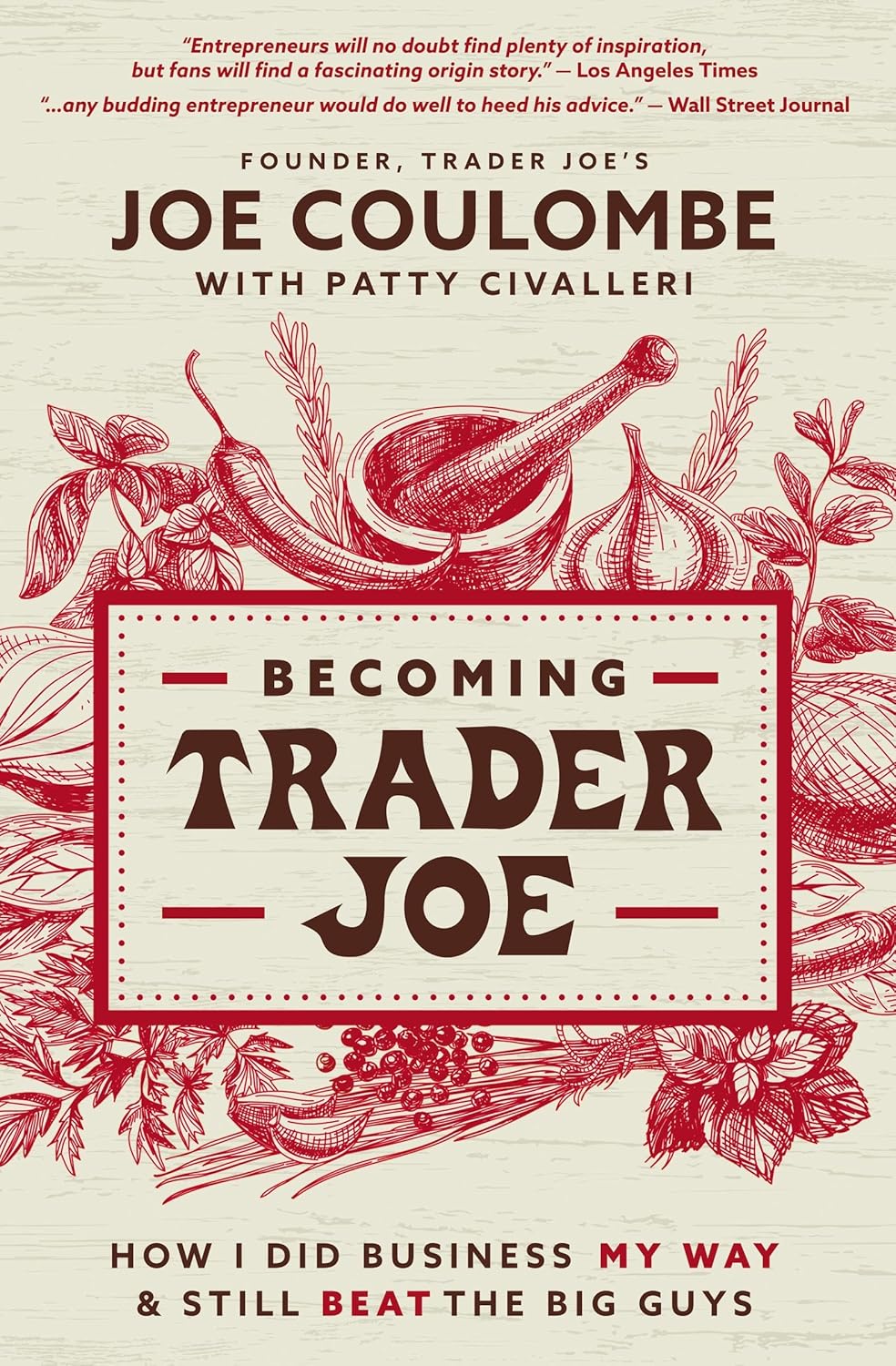
Becoming Trader Joe: How I Did Business My Way and Still Beat the Big Guys by Joe Coulombe. A founder’s memoir. Part business philosophy, part personal history, written with the same literary wit that defined the brand.
How to Read This
73 highlights organized into 17 themes. Each theme has the original quotes. Use the sidebar to jump between themes. The 14 takeaways at the end pull the lessons together.
Theme 01

Pay People Well

Coulombe is clear: paying employees more than anyone else in retailing was the foundation. Not culture. Not product. Compensation.

“Time and again I am asked why no one has successfully replicated Trader Joe’s. The answer is that no one has been willing to pay the wages and benefits, and thereby attract—and keep—the quality of people who work at Trader Joe’s.”
“‘But how could you afford to pay so much more than your competition?’ The answer, of course, is that good people pay by their extra productivity. You can’t afford to have cheap employees.”
“In 1988, median family income in California was $32,000. The average full-time employee at Trader Joe’s made $34,000, excluding any bonuses or overtime pay (that is, pay in excess of the basic forty-eight-hour week) or triple time for Thanksgiving.”
“The Captains had that salary plus a bonus that theoretically had no limit. The bonus was based on Trader Joe’s overall profit, allocated among the stores based on each store’s contribution. In 1988, several Captains made bonuses of more than 70 percent of their base pay. I don’t believe in bologna-slice bonuses. Unless a bonus system promises, and delivers, big rewards, it should be abandoned.”
“Part-timers. There is no such category except on the dumbed-down basis of hours worked. We had many part-timers who were graduate students, probably smarter than some of the full-timers. At a time when the minimum wage was $4.35, we often paid $13.00 per hour because these people were worth it.”
“Generally, labor expense in grocery retailing is relatively small, compared with manufacturing or the professions or restaurants. This was one reason I could get away with Trader Joe’s high compensation policies. Cost of Goods is the dominant expense. The funny thing is that grocers seem to spend more effort squeezing payroll than squeezing Cost of Goods Sold, though there is at least five times more opportunity to save money in the latter.”
“I want to brag about something here: in thirty years we never had a layoff of full-time employees. Seasonal swings in business were handled with overtime pay to full-time employees, and by adjusting part-time hours.”
Theme 02

The Overeducated, Underpaid Customer

Trader Joe’s was built for a demographic no one else was serving. Coulombe understood them because he was one of them.

“We always looked up to the customers in the text of the Fearless Flyer. We assumed they knew more than they did; we never talked down to them.”
“There was a particular angle to the naming of our products. I wanted to create a silent conspiracy among the overeducated, underpaid people in town, so that as they moved down the aisles they would read secret messages on the products.”
“Instead of having a one-size-fits-all private label like the supermarkets, we tried to individualize each label to each product. Wherever I could, I used artistic, or musical, or literary, or historical, or scientific allusions in the product names. Thus: the Brandenberg Brownies, the Sir Isaac Newtons, The Bagel Spinoza, The Peanut Pascal, Disraeli & Gladstone’s British Muffins. My favorite was Heisenberg’s Uncertain Blend of coffee beans... How many customers had ever heard of Heisenberg? Not many. But the ones who understood the joke were literally bonded to us forever.”
Theme 03

Product Knowledge as Competitive Advantage

The biggest departure from conventional retail. Walk away from branded merchandise and know your products better than anyone.

“I felt that a dichotomy was developing between ‘groceries’ and ‘food.’ By ‘groceries,’ I mean the highly advertised, highly packaged, ‘value added’ products being emphasized by supermarkets. By embracing these ‘plastic’ products, I felt the supermarkets were abandoning ‘food’ and the product knowledge required to buy and sell it.”
“We fundamentally changed the point of view of the business from customer-oriented to buyer-oriented. I put our buyers in charge of the company.”
“What so many would-be competitors didn’t understand is that Trader Joe’s was never a store of far-out ‘gourmet’ foods, but a store of basics: oils, breads, cheeses, coffees, canned fish, nuts, jams, chocolate.”
Theme 04

The Power of Discontinuity

Built on supply/demand imbalances that big retailers couldn’t touch because of their own size.

“Once the virtual distribution system started working, its logistics were so good that we could buy some branded merchandise and sell it for less than the supermarkets, partly because we were willing to exchange one low landed cost for all the bells and whistles of ad allowances, slotting, etc.”
“Wine merchandising: Pineapple from the island of Maui (as opposed to just ‘Hawaii’). Concord grape juice from the 1981 harvest. Above all: Because almost all of our purchases of wines were in limited, or at least delimited, quantity, we always announced how many cases we had. This carried over to all other products in the Fearless Flyer.”
Theme 05

Intensive Buying vs. Buying Power

Buying power is passive: bulk discounts. Intensive buying is active: finding value through knowledge, relationships, and speed.

“Vendors should get prompt decisions. Some of our greatest coups were generated by our commitment to make an offer within twenty-four hours of a presentation. Desperate vendors knew they would not be strung out by a constipated buying procedure. They might not like the offer they got, but by God they got an offer.”
“Vendors should be regarded as extensions of the retailer, a Marks & Spencer concept. Their employees should be regarded almost as employees of the retailer. Concern for their welfare should be shown, because employee turnover at vendors sometimes can be more costly than turnover of your own employees.”
“Vendors’ manufacturing plants should be visited frequently, especially by your quality control people. Marks & Spencer is famous for its quality control people. Once I visited a Brie factory in France that supplied both M&S and Trader Joe’s. That day the plant management was sweating blood, because the M&S quality control people were visiting.”
Theme 06

The Limited Assortment

No category allocations. No “complete lines.” Every item earns its place or gets cut.

“Carry individual items as opposed to whole lines. We wouldn’t try to carry a whole line of spices, or bag candy, or vitamins. Each SKU had to justify itself, as opposed to riding piggyback into the stores just so we had a ‘complete’ line.”
“Each SKU would stand on its own two feet as a profit center. We would earn a gross profit on each SKU that was justified by the cost of handling that item. There would be no ‘loss leaders.’”
“Above all we would not carry any item unless we could be outstanding in terms of price (and make a profit at that price) or uniqueness.”
“Be willing to discontinue any product if we are unable to offer the right deal to the customer.”
“The willingness to do without any given product is one of the cornerstones of Trader Joe’s merchandising philosophy.”
“What SKUs do you drop to make room for new ones? Mostly we did it on the basis of dollar value of sales. We made no effort to have a complete assortment. No sugar, salt, flour, unless we could be outstanding in it, and make a sufficient number of dollars from it.”
“Rather, I challenged our buyers to find a certain number of additional basic products each year that would sell so well they would force us to drop other products. There were no allocations of SKU-counts by category.”
“Retailers seem to be falling into two distinct SKU modes: those with under 4,000–5,000 SKUs and those with over 25,000 SKUs. Curiously, the ‘Over 25,000’ retailers rarely assert the superiority of their assortment in any department.”
Theme 07

The Power of Small Stores (“Chunking”)

Small format wasn’t a limitation. It was a deliberate advantage: better people, better products, better decisions.

“I believe in having enough stores so you’re hedged against getting wiped out by a single fire or earthquake. But my preference is to have a few stores, as far apart as possible, and to make them as high volume as possible.”
“Sales per store, sales per square foot: those are the measures I look at. Trader Joe’s sales were $1,000 per square foot of total area. The supermarket average is $570.”
“When you deliver value, you don’t have to worry about in-store convenience. At Trader Joe’s we never worried about in-store convenience. The check stands are still not flow-through: I think that seeing a row of check stands when one enters a supermarket is about as attractive as seeing a row of urinals.”
Theme 08

Tenacity Over Brilliance

A reasonable strategy stuck with beats a brilliant strategy abandoned too early.

“Trying to find an optimum solution in business is a waste of time: the factors in the equation are changing all the time.”
“If all the facts could be known, idiots could make the decisions. —Tex Thornton, cofounder of Litton Industries. This is my favorite of all managerial quotes.”
“The economist, Joseph Schumpeter, was absolutely right: Innovation is less an act of intellect than an act of will.”
Theme 09

White Papers

Coulombe wrote everything down. Not for the record, but to force clarity and invite dissent.

“I took a cue from General Patton, who thought that the greatest danger was not that the enemy would learn his plans, but that his own troops would not.”
“In November 1987, I outlined to the buyers where I thought we should go: ‘We want continuous products. Any sane person does. The trick is to have continuous products which are profitable without creating a high-price image.’”
Theme 10

Employee Listening

The people closest to the work know what’s wrong. Build a system that lets you hear them.

“Equally important was our practice of giving every full-time employee an interview every six months. At Stanford I’d been taught that employees never organize because of money: they organize because of un-listened-to grievances. The principal purpose of this program was to vent grievances and address them where possible.”
“How do you judge a Captain? It’s simple. Good Captains don’t have bad inventories. A bad inventory usually means employee theft. But this good, gross result is always the result of meticulous micro-care in running the store, especially in the indoctrination and training of part-timers.”
Theme 11

Pricing Philosophy

Every item makes money. You don’t react to competitors. You set the market.

“During my tenure, Mac the Knife happened to run on a gross profit of about 23 percent after all distribution costs. But that was an after-the-fact result. We never aimed specifically to hit 23 percent. Our approach was to find out what the going price was for a given SKU and then undercut the market.”
“I was willing to make only 13 percent on a $20 bottle of champagne, because that was a $2.60 profit. For a $2.00 item, however, I wanted to make a much greater percentage. We persistently got rid of anything that sold for less than a dollar.”
Theme 12

Focus: Buy and Sell, Outsource the Rest

Trader Joe’s stripped away every non-core function years before it became fashionable.

“Hairballs: Their greatest danger is that they consume management stamina that is needed to deal with the Matrix Issues.”
“All businesses have problems. It’s the problems that create the opportunities. If a business is easy, every simple bastard would enter it.”
Theme 13

Real Estate

Leases are irreversible. Coulombe treated them with the gravity most retailers save for acquisitions.

“The forty-page lease form itself was one of the most valuable assets I got from my years at Rexall. That lease form was ‘tenant-oriented.’ I never would have dared to ask for things that Rexall took for granted.”
“The ‘normal distribution’ of most chains is 20 percent dogs, 60 percent okay stores, and 20 percent winners. I believe in ruthlessly dumping the dogs at whatever cost. Why? Because their real cost is in management energy. You always spend more time trying to make the dogs acceptable than in raising the okay stores into winners.”
“Most problems in leasing are created by the need to deal with the future: the longer the lease, the more significant the problems in negotiating the lease.”
Theme 14

Cash as Weapon

Liquidity isn’t conservative. It’s what lets you pounce on opportunities others can’t.

“To keep sales increasing during the mid-1970s, we relied on new ideas implemented in existing stores. This was my favorite form of growth. I don’t think that any given store ever fully realizes its potential.”
Theme 15

Honest Mistakes

Coulombe is open about his failures and what they taught him.

“One of the hardest things to drop was the assortment of California boutique wines. My problem wasn’t so much with the customers as with our employees, most of whom had now logged twenty years as premier retailers of these wines. They felt the loss of many long-term relationships. It was, therefore, primarily a Supply Side issue of employee morale.”
“Freshness has a powerful appeal. When Whole Earth Harry introduced orange juice that was squeezed on the premises, it was a great Demand Side success. But it was also a total nightmare to administer... The day we announced no more squeezed orange juice, the Captains cheered.”
“I have to admit the truth, that I regret having sold Trader Joe’s. And I have had to pay something for this, beyond the loss of my shadow.”
Theme 16

Conceptual Integrity

Borrowed from software architecture. Coherence matters more than features.

“‘The purpose of a programming system is to make a computer easy to use.’ ‘Ease of use is enhanced only if the time gained in functional specification exceeds the time lost in learning, remembering, and searching manuals.’ ‘Simplicity and straightforwardness proceed from conceptual integrity. Every part must reflect the same philosophies and the same balancing of desiderata.’”
Theme 17

Miscellaneous Wisdom

Stray insights that didn’t fit a single theme but were too good to cut.

“Governmental intrusion can be considered as a Supply Side opportunity. The retailer who masters the skills of dealing with the regulatory authorities erects a threshold that his competitors will have to cross.”
“One of the most important employee benefits that I installed back there in 1963 was Income Continuation Insurance. It took the monkey off our back if an employee got sick for a protracted period of time.”
“The combination of internal theft, vendor theft, bad checks, armed robbery, and burglaries can be overwhelming at times. An entire chapter, ‘Crime Side Retailing,’ could be written because that’s how I spent half of my time.”
“Instead of national brands, focus on either Trader Joe’s label products or ‘no label’ products like nuts and dried fruits. This was intended to enable the Trader Joe’s label to pick up momentum in the stores.”
Synthesis

Key Takeaways

01
Pay people more than anyone else.
Not generosity. It’s the cheapest path to productivity, tenure, and quality. Great people more than pay for themselves.
02
Know your customer so well you can create a silent conspiracy.
Trader Joe’s was built for “overeducated, underpaid” people. Every product name and Fearless Flyer paragraph winked at that tribe.
03
Product knowledge is the moat.
Walking away from branded merchandise forces you to understand what you’re selling. That knowledge becomes the advantage no one can copy.
04
Build on discontinuity.
Find supply/demand imbalances that big players can’t touch because of their scale. Being small is an advantage when the opportunities are small too.
05
Each SKU is a profit center.
No loss leaders. No “complete lines.” No items riding on category inertia. Every product earns its spot or gets cut.
06
Tenacity beats brilliance.
A reasonable strategy stuck with beats an optimum strategy abandoned. Stop looking for perfect answers. The factors are changing all the time.
07
The fundamental job is buying and selling.
Outsource everything else. Every non-core function you own drains management energy from what actually matters.
08
Write it down before you do it.
White papers force clarity, prevent revisionism, and invite your team into the thinking.
09
Listen to the front line.
The people closest to the work know what’s wrong. Build systems that let you hear them.
10
Small stores, high volume, few locations.
Sales per square foot matters more than store count. Dump the dogs. Their real cost is management energy.
11
Cash equals optionality.
Keep two weeks of sales in cash at all times. That lets you pounce on deals that debt-loaded competitors can’t touch.
12
Never price-match.
Set the price where it should be and stick with it. Reactionary pricing is intellectually feeble.
13
Leases are the most dangerous decision.
Treat real estate with the gravity of an irreversible investment. Bad leases kill more retailers than bad products.
14
Conceptual integrity over feature count.
A coherent system that omits features is better than an incoherent system that has everything.